

Product & Tools
Power dialer vs parallel dialer: which one for B2B cold calling?
Power dialer: one number at a time. Parallel dialer: up to 5 lines, the rep joins the first pickup. Differences, math, risks and when each one fits.

A power dialer calls one number at a time. A parallel dialer calls up to 5 at once and connects you to the first person who picks up. If cold calling is your main channel, the parallel dialer wins on conversations per hour.
What is a power dialer?
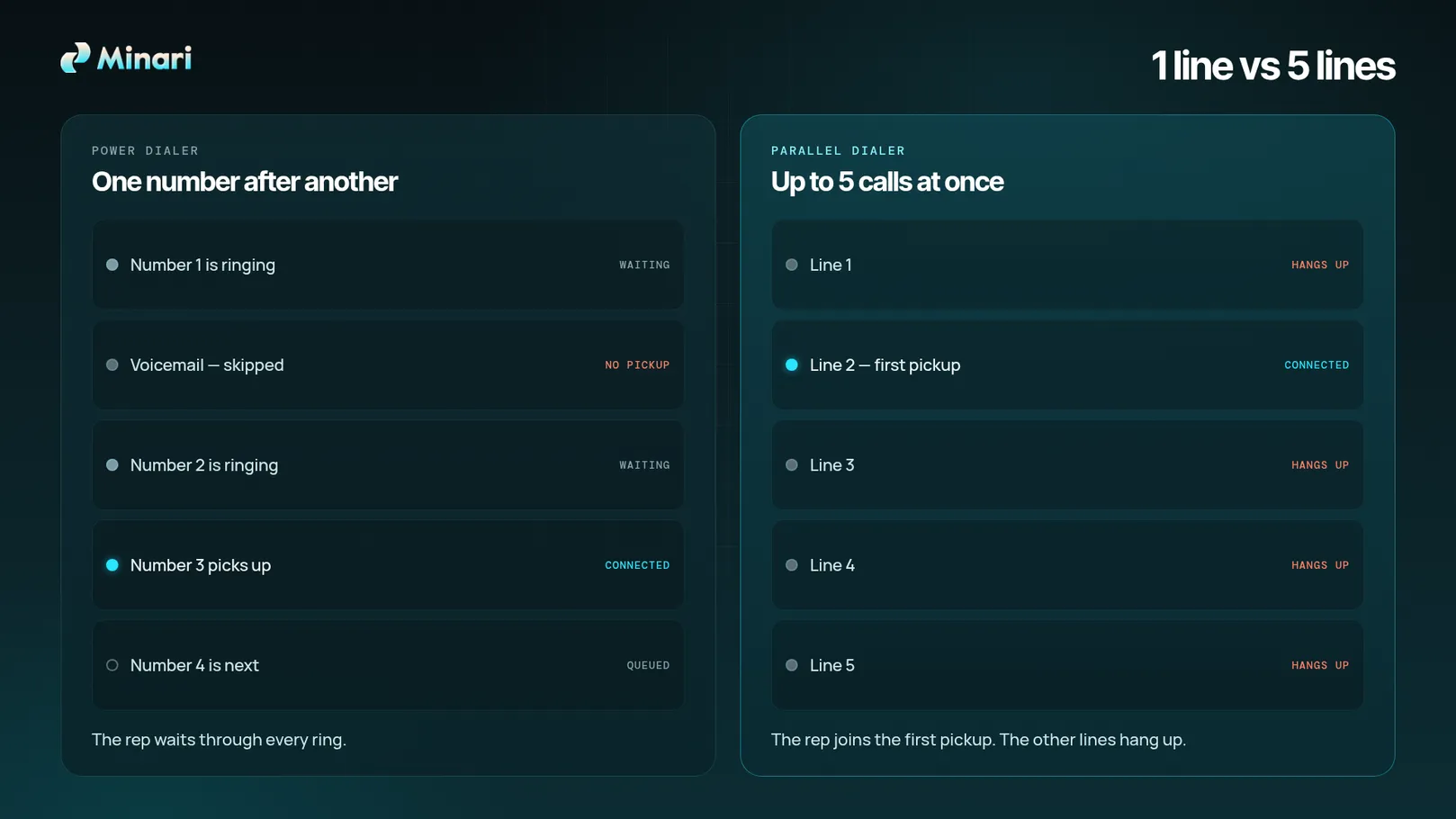
It automates the dialing. You load a list, the tool calls the first number, and when the call ends it calls the next one. You do not type numbers or click.
You still wait. Some power dialers detect voicemails and skip them, but calls still go out one at a time, so the rep waits through every ring before knowing if someone picks up.
What is a parallel dialer?
It calls several numbers simultaneously, from 1 to 5. When a prospect picks up, the call goes to the rep. The other lines hang up. Voicemails and invalid numbers are filtered out before they reach the rep.
The rep waits less, and talks to more people in the same hour.
Power dialer vs parallel dialer: how do they compare?
| Power dialer | Parallel dialer | |
|---|---|---|
| Calls placed at once per rep | 1 | 1 to 5 |
| Who is connected | The rep, after each ring | The rep, to the first pickup |
| Waiting time for the rep | Rings, voicemails | Very little |
| Typical use | Small market, low volume, occasional cold calling | Deep market, cold calling as the #1 acquisition channel |
What does the difference change in numbers?
Minari's guide uses 20 manual calls per hour. For a power dialer, our own estimate is about 40 calls an hour, since the tool removes the dialing but the rep still waits through every ring. Take one hour of calling, at a 10% connect rate:
- Manual dialing: 20 calls, 2 pickups.
- Power dialing: 40 calls, 4 pickups.
- Parallel dialing: 150 calls, 15 pickups.
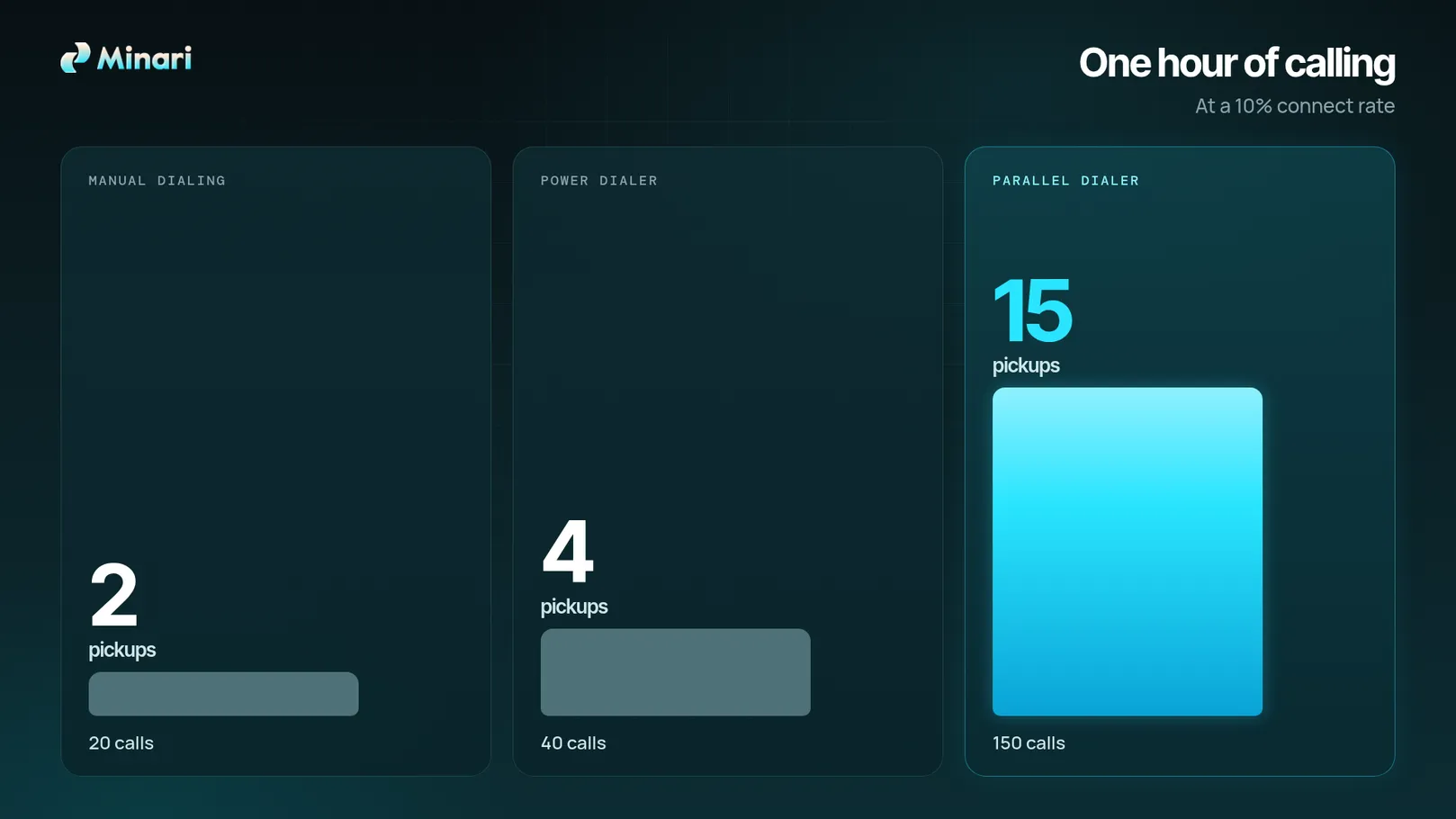
The 10% is an example. Your own rate depends on your list, your persona and the time of day: see the connect rate benchmark by persona.
With a parallel dialer, the number of calls per hour depends on your connect rate. The more people pick up, the more time you spend talking, so the fewer calls you make:
| Connect rate | Calls per hour | Pickups per hour |
|---|---|---|
| 5% | 200 | 10 |
| 10% | 150 | 15 |
| 15% | 100 | 15 |
| 20% | 80 | 16 |
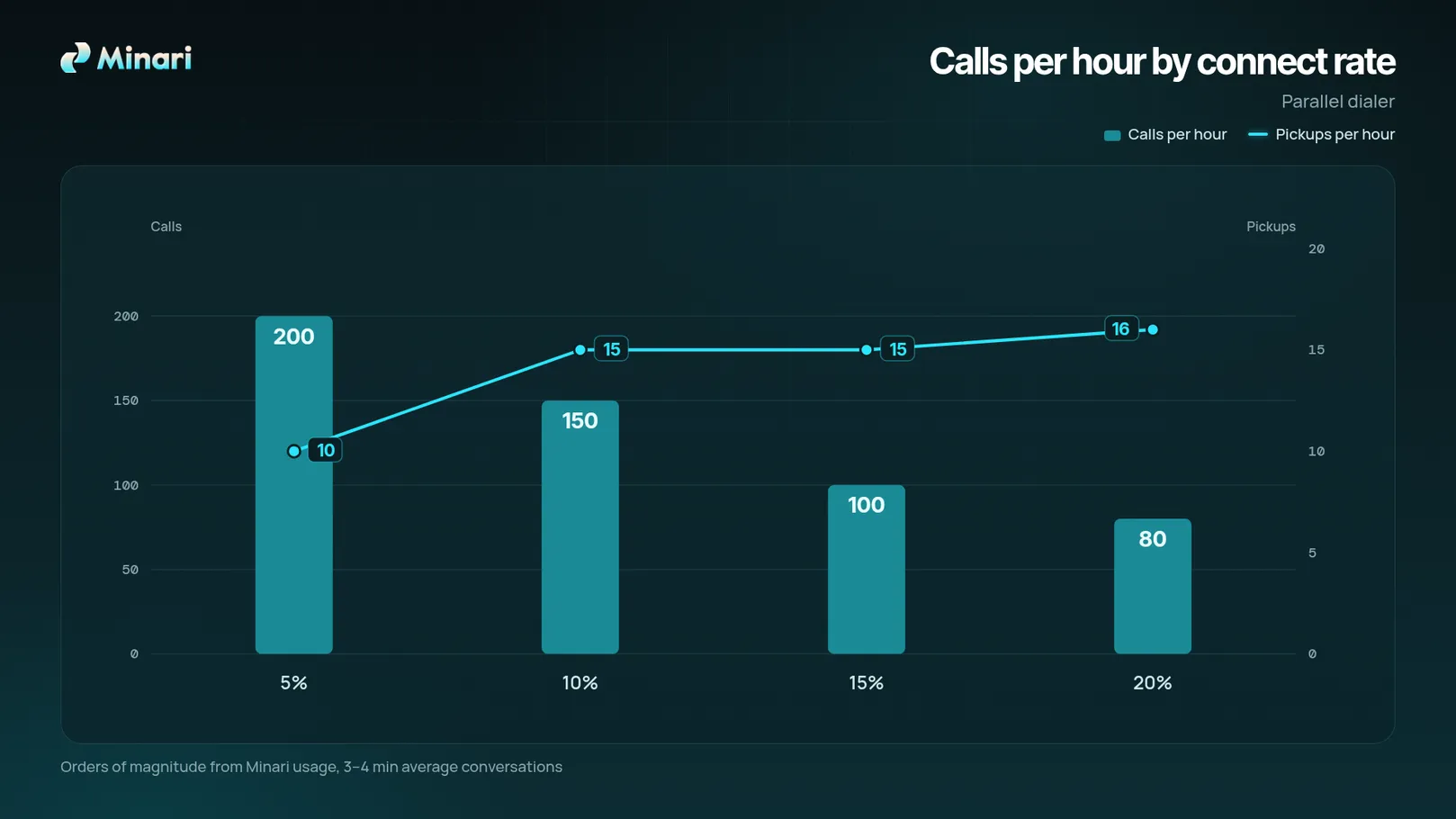
These are orders of magnitude from Minari usage, based on conversations of 3 to 4 minutes on average (the usual length of a call that books a meeting). They are not guarantees.
When is a power dialer enough?
- Your lists are small and carefully researched, with a few calls a day per account.
- Your reps mostly make follow-up calls to people who expect them.
- Your reps do not cold call every day, only from time to time.
- Your market is small, with a limited number of companies and contacts to call.
When does a parallel dialer fit?
- Large lists of mobile numbers, where most calls end in voicemail or no answer.
- Reps who make several hours of calls per day.
- Teams that measure conversations per hour and want to raise that number.
- Cold calling is your main acquisition channel and you want to take it to the next level.
- Your market is deep, with thousands of companies and contacts you can call.
The risks of a parallel dialer
- It amplifies weak calling. A parallel dialer puts you in front of more people. If your pitch and objection handling are not good yet, you will just fail faster, with more prospects.
- You need more contacts. At 150 calls an hour, you go through a list much faster. If building lists is already a struggle and you have no tool for it, you will spend much more time feeding the dialer.
- You need good list segmentation. Calling more people only pays off if they are the right people. Segment by persona, industry and company size before you dial. A well-segmented list lets you tailor your pitch to each group, which means better conversion rates.
- Spam labels. More calls per hour can push a number toward a spam-likely label.
What this does not say
The numbers above come from Minari customers who chose a parallel dialer. They do not prove that every team will reach 150 calls an hour. Your connect rate and the length of your conversations also set the number of calls per hour: the more people pick up and the longer you talk, the fewer calls you make. Lists, time of day and rep behavior change the result too. Run both tools on the same list for a week and compare conversations per hour.
FAQ
What is the difference between a power dialer and a parallel dialer? A power dialer calls one number at a time. A parallel dialer calls up to 5 at once and connects the rep to the first pickup.
How many calls an hour can I expect? Around 20 manually, around 40 with a power dialer, and around 150 with a parallel dialer at a 10% connect rate. It depends on the list.
Does a parallel dialer create silence on the line? Not with Minari: when a prospect picks up, the rep is connected instantly, with the CRM record already on screen. With other tools, call real prospects and notice whether the connect feels instant.

More conversations, less waiting
Your reps go from 100 calls a day to 100 calls an hour. See Minari in action on your own lists.
Request demo